SAMPLE PRESCRIBING REPORT
LAXATIVE USE
 |
Are people on long term opiates being prescribed stimulant laxatives?
National picture
Long term opiate use frequently results in constipation and it is recommended that people on long term opiates also receive a stimulant laxative. This is because constipation almost always occurs (due to reduced gut motility) and tolerance to the effect does not occur. We decided to look at dispensings for people on opiates and see if they were also dispensed oral stimulant laxatives. Oral stimulant laxatives include bisacodyl, senna and docusate with senna (Laxsol). Docusate with senna is an ideal combination for people with opiate induced constipation. In addition to these, we included docusate (Coloxyl) on its own because although it is primarily a faecal softener it does have some stimulant activity.
| Oral laxative use among patients dispensed opiate analgesics 1 December 2006 - 31 May 2007*: |
|||||||||||||||||||||||
first... |
|
||||||||||||||||||||||
next... |
|
||||||||||||||||||||||
finally... |
|
||||||||||||||||||||||
This data shows there is room for movement and serves as a reminder to consider prescribing a stimulant laxative for people on long term opiate medication.
Multiple laxative use and drugs that can cause constipation
A number of drugs can cause or exacerbate constipation. We thought it would be interesting to look at how many people taking laxative(s) were on drugs likely to exacerbate or cause constipation.
The drugs that we considered could be causing or exacerbating constipation are listed below. It is by no means a complete list:
|
|
|
|
There are four classes of laxatives described in the PHARMAC schedule: bulk-forming agents, faecal softeners, osmotic laxatives and stimulant laxatives. We divided the people who had been prescribed a laxative in the time period into those who had been prescribed laxatives from one, two, three or all four of these classes. For these groups we then looked to see what percentage were on a drug which can cause constipation.
National pictureFigure one shows that the more classes of laxative people are prescribed the more likely they are to be taking one of the drugs that are likely to be causing or exacerbating the constipation. |
Figure One: National patients on laxatives*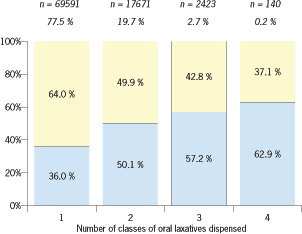 |
|||||||||
A GP’s prescribingIt is indicative only, intended to reinforce our message of checking for drugs that cause constipation before prescribing additional laxatives. Patients were assigned to a GP if they were dispensed at least one laxative on a prescription with their NZMC number. Other laxatives or the drug(s) which can cause constipation may have been supplied by other prescribers.
|
Figure Two: A GP's patients on laxatives*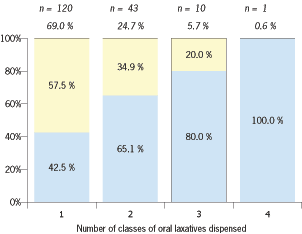 |
|||||||||
The take home message is that if you are considering adding a second laxative to a patient’s treatment regimen it is worth checking if they are on a medication that might be causing the problem. You may be able to modify the dose or find an alternative.
*Notes to Data:
Time period is 1 December 2006 to 31 May 2007.
Laxatives include oral presentations only.
Data has been excluded where the NZMC number or NHI number was not recorded.
For the purposes of this report, ‘Stimulant Laxative’ is defined as follows:
| Docusate sodium | Bisacodyl | |
| Docusate sodium with sennosides | Senna |
| (1) Bulk-forming Agents; | (2) Faecal Softeners; | |
| (3) Osmotic Laxatives; | (4) Stimulant Laxatives. |